Photo: "Sunday Funday"

Greystone _MG_6268-Edit.jpg

Inside the main Administration Building of Greystone Psychiatric Hospital lies a chapel, with wood paneling, complete with its own pipe organ.

Greystone Psychiatric Hospital was built on the Kirkbride plan in 1871 to relive the overcrowding of nearby Trenton State Hospital. This last patients at Greystone left in 1988, but it wasn't until 2000 that a decision was made to close the hospital.

Allied Defense Recycling Makes History at Mare Island

_MG_8570-Edit.jpg

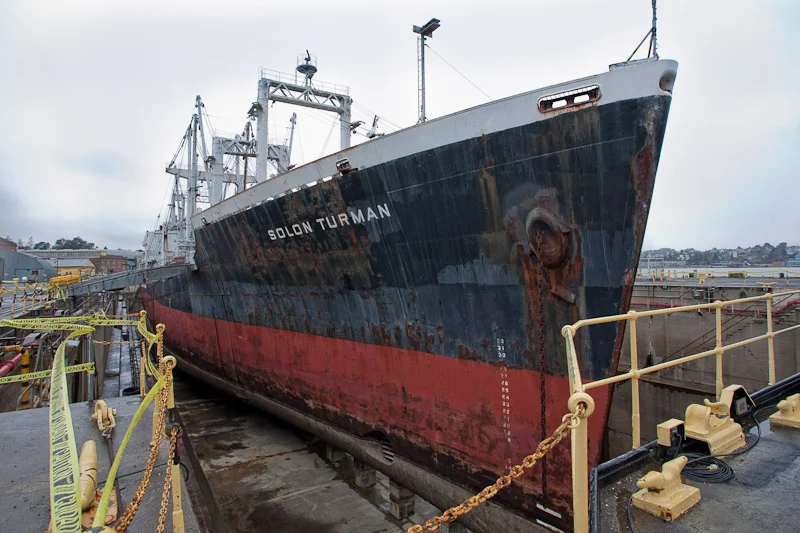
This morning at 1000 hours , Allied Defense Recycling, MARAD and the City of Vallejo held an Open House and Ribbon Cutting Ceremony for the new Allied Defense ship dismantling facility at Mare Island.

Mare Island, the first Shipyard to be built on the West Coast, has remained closed since 1995 as a direct result of the Base Realignment Closure Program. This event marked the official reopening of the 740 foot dry dock #2 after 16 years of dormancy. 

Since SS Solon Turman was towed into the dry dock 2 weeks ago, dozens of workers have lined up each morning hoping to get hired. Thus far, Allied Defense Recycling has hired a handful of workers and will continue to hire workers, up to 100 or maybe more, once major operations begin.

ADR Mare Island _MG_8598-Edit.jpg

In 2010, Allied Defense Recycling received the MARAD contract to scrap two ships. S.S. Solon Turman is currently sitting in the dry dock. The next ship, S.S. President, is scheduled to arrive in March. Of the 20 ships scheduled to be removed from the Mothball Fleet by Sept 30, 2011, it hasn't been said how many will end up at Mare Island.

ADR Mare Island IMG_7816-Edit.jpg

The presentation was held inside the former periscope maintenance building. Speakers included: Jay Anast (Director of Operations, ADR), Mayor Osby Davis and David Matsuda (Director, MARAD).

_MG_8586.jpg
IMG_7834.jpg

Jackling House

Jackling IMG_3193-Edit.jpg

HISTORY

Jackling.jpg

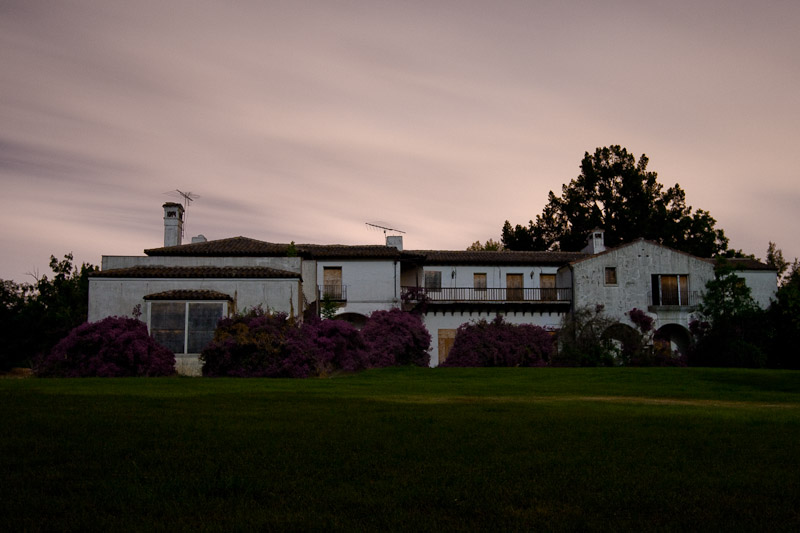
In 1925, famed architect George Washington Smith, famous for his Spanish Colonial Revival Style in Santa Barbara, designed and built a 14 room, 17,000 sq foot mansion for copper-mining baron Daniel Jackling in Woodside, California.

Jackling was born in 1869 and educated in mining and metallurgy at The Missouri School of Mines. He became known for his revolutionary methods regarding the processing of low-grade copper ores and the establishment of the Utah Mining Company in 1903. He went on to become a very successful executive with hands in a number of Western Copper companies. In fact, it has been said that 60% of the world's copper production was a direct effect of Jackling's development of his ore processing.

During the second World War, Jackling was honored for his outstanding wartime efforts, for serving as director of government explosive plants, and was awarded the Distinguished Service Medal by President Woodrow Wilson. He was also honored by the Western Society of Engineers with the Washington Award for "pioneering in large-scale mining and treatment of low-grade copper ores, releasing vast resources from formerly worthless deposits."

In 1956, at age 87, Jackling died in his Woodside home and after Mrs. Jackling's death in 1957, the property was subdivided  and the Jackling's wealth was given to various organizations and charities, including Stanford University.

In the 1960's daughter of Bank of America's A.P. Giannini, Claire Giannini Hoffman, bought the parcel of land that contained the Champagne Paddocks, the estate's stables. In 1962, when Bing Crosby visited the property for a GOP fundraiser, he admitted to loving the house so much he wanted to buy it. Bill & Hilary Clinton also paid a number of visits to the house.

Apple CEO Steve Jobs purchased the house in 1984 and took residence for 10 years. In 2001, he petitioned to demolish the house and outbuildings. Tearing down a George Washington Smith house is neraly unheard of in Santa Barbara, where he constructed most of his work, and it wasn't understood in San Francisco either.

In 2004, Jobs finally received permission to tear the house down, but he received strong opposition from local preservationists; the "Upload Our Heritage" (UOH) Group. This battle went on for years and in 2006, he was told he could not demolish the house. Again in 2008 he submitted a request for demolition. Finally in Apri 2010, Jobs was given final permission to rid the property of the house.

Demolition on the house began on Monday, February 14th.

RECENT PHOTOS

Jackling IMG_3190-Edit.jpg
IMG_3197.jpg
Jackling IMG_3202-Edit.jpg
Jackling IMG_3172-Edit.jpg
Jackling IMG_3170-Edit.jpg
_MG_0825.jpg

Photo: "Stand Down"

Mothball Fleet _MG_8465-Edit.jpg

Battleship U.S.S. Iowa contains three 16"/50 caliber Mark 7 guns. The turrets were called "three-gun" (rather than "triple") because each gun could be angled and fired independently of the others. These guns were 66 feet long and fired projectiles weighing anywhere from 1,900 to 2,700lbs at a max speed of 2,690 feet per second for up to 24 miles.

This world class battleship currently sits in the Suisun Bay Reserve Fleet awaiting her fate. Currently there is a batte between Long Beach and Mare Island as to where the ship will be docked and turned into a museum. The Navy seems to have chosen Mare Island as the ship's home, but San Pedro seems to have more funding and monetary support.

U.S.S. Wichita (AOR-1)

wichita-ii.jpg

The hull of U.S.S. Wichita was laid down in Quincy, Massachusetts by General Dynamics Quincy Shipbuilding Division in 1966. She was the first of the Wichita Class Replenishment ships to see service. (She was later joined by USS Milwaukee, USS Kansas City, USS Savannah, USS Wasbah, USS Kalamazoo and USS Roanoke.)

She was comissioned in July 1969, after a final outfitting at the Boston Naval Shipyard.

U.S.S. Wichita was equiped with twin Phalanx Close-In Weapons Systems for anti-missile/anti-aircraft defence. Eventually, this was supplemented with single Sea Sparrow MK 29 missile launchers which protected against surface and air threats by utilizing the Rim-7 NATO SeaSparrow Missile. She also had the ability to support (2) CH-46 Sea Knight helicopters if necessary.

TAO_1987_Wichita.jpg

After a long trek through the Panama Canal she arrived on the West Coast in Long Beach, which became her temporary home port, where she remained for a few months before being deployed to support ships in the Vietnam War. During her time there, she earned four battle stars and an Armed Forces Expeditionary Medal, which was for replenishing 23 ships within one day, and years later was also awarded a "Battle Efficiency Award" (Battle E). 

Her last West Pacific tour of duty was in 1989, but she had some short deployments to British Columbia, Oregon and Mexico. 

She provided over 30,000,000 gallons of oil and gasoline and 10,000 tons of ammunition to over 240 ships throughout her 24 years of service until she was decomissioned in 1993. 

In 1998 she was transfered to Suisun Bay and became a member of the Reserve Fleet where she has sat ever since.

Mothball Fleet _MG_8435-Edit.jpg

Inside the 'Treatment Room' where two operating tables and a dentist chair were installed for patient care.

Mothball Fleet _MG_8448-Edit.jpg

Dentist chair inside the 'Treatment Room' on the 01 Level.

Mothball Fleet _MG_8455-Edit.jpg

Inside the 1st deck crew mess.

Mothball Fleet _MG_8458-Edit.jpg

Crew bunks on the 1st deck.

Mothball Fleet _MG_8459-Edit.jpg

Checker tables on the 1st deck. 

U.S.N.S. Edwin D. Patrick

I just discovered that the most recent ship towed out of the Suisun Bay Reserve Fleet, U.S.N.S. Edwin D. Patrick, was one of the ships I had the priviledge to explore on a recent trip to the Fleet.

She was first of the 6 ships, towed out of the fleet, that I have had the chance to photograph, which is why I'm a bit sadenned by the news. While that might sound strange to many of you, it's something that happens to us explorers/photographers when we see a place we've visited often be demolished or renovated.

Throughout the last year, I've made a number of trips to the Fleet and each time, I discover something new, which leads to a stronger attachment to the ships. This ship in particular was interesting to me because she was a troop transport ship and contained many elements most military ships do not, such as a monetary exhange booth, theatre, church and rec room.

During my trip to the Fleet, I was told that U.S.N.S. Edwin D Patrick and her sister ship, U.S.N.S. General John Pope had been sold for scrap, but there was no indication of when this would occur. 

U.S.N.S Edwin D Patrick was a troop transport ship commissioned in 1945. In 1950, the Navy reclaimed the ship and placed into Military Sea Transportation Service, where she served as a transport ship during the Korean War. She was decommissioned in 1967 and places in Suisun Bay shortly thereafter. In 2005, she was scheduled to be transported to Alang, India for scrapping, but concerns about the condition of her hull prevented this from occuring. In March 2010, U.S.N.S. Edwin D Patrick was sold to ESCO Marine in Brownsville, Texas.

She was towed out of the fleet on April 15, with no announcement in the media or on the Port of San Francisco roster. She now sits in the dry docks at BAE Systems in San Francisco awaiting her trip to Texas to be scrapped.

Photo by Dave R

Photographer Showcase: Rustyjaw

I stumbled upon Rustyjaw's flickr, when I just started to become serious about photography and wanted to learn about HDR's. I must admit, it was an incredibly refreshing find.

Prior to that, I never liked HDR's, in fact I avoided trying them myself because I always saw examples that resembled an altered reality with their incredibly saturated colors, soft focus and unrealistic contrast. I never believed in an HDR subtlety, until I saw his work.

I was enamored by his talent for processing incredibly realistic, beautifully toned and detailed photos. Not only that, but his eye for intriguing compositions and his unique creative style completed the triptych of skills photographers should posess.

Every photo submerges the viewer into his world as he documents the old relics, slowly fading from our lives.

You can find more of his work on his website or check out his recent DSLR video projects here.

Photo-documenting the Colorado River Bridge / Hoover Dam Project

HooverDamProject.jpg

Photo by Jamey Stillings

Photographer Jamey Stillings has been following the Colorado River Bridge / Hoover Dam Bypass project since March of 2009 when he first encountered the construction site. Since then, he has photo-documented the project and the construction of the future new vehicle route diverting traffic around the dam, a 1900 ft bridge.  This new bridge requires thew creation of a 1,060 ft arch spanning the Black Canyon between Arizona and Nevada. When the project is complete, it will be the longest concrete arch span in the US and the fifth longest in the world.

Check out Part I & Part II of Jamey's absolutely incredible photos.