

Collapsing second foor of the male wards at Hudson State Hospital.
Photo: "Synchronicity"

The diffused setting sun lights the Brigham building at Norwich State Hospital in Connecticut.
U.S.S. Iowa BB-61: Benicia to Richmond

On Thursday October 27, 2011, USS Iowa was removed from the Suisun Bay Mothball Fleet and placed at the Port of Benicia, where she spent one night before beign transferred to Richmond. For the next three months, USS Iowa will undergo significant refurbishment before making the long journey to Berth 87 in Los Angeles where she will become an interactive museum.
The battle this ship has experienced since her decomissioning was politically based and spanned across the past ten years as she sat in Suisun Bay. There was always a push to turn the battleship into a museum in San Francisco, but the Board of Supervisors was against mooring a miliitary ship based on a "homophobic entity" within the confines of the city, which caused other organizations to raise money in the hopes to move the ship to another California dock.
USS Iowa is the last of four remaining battleships of its kind and the last of the four to be turned into a museum. The 887 foot long USS Iowa, built in 1940, was the fastest ship in her class of battleship and the only ship of her class to have served in the Atlantic Ocean during World War II. Her main battery consisted of nine 16"/50 Caliber Mark 7 guns which could fire 2,700lb shells approximately 20 miles.
In 1989, during a gunnery excersise, an explosion occurred in the center gun room destroying Turret #2 and killing 47 sailors.
The ship was decomissioned in 1990 and placed in the Suisun Bay Reserve Fleet short thereafter.

Port of Benicia

Leaving the Port of Benicia

Approaching the Carquinez Bridge

USS Iowa after passing under the Richmond Bridge

Nearing Berth 3 in Richmond

Tugboat pushes USS Iowa towards the pier

Aft guns
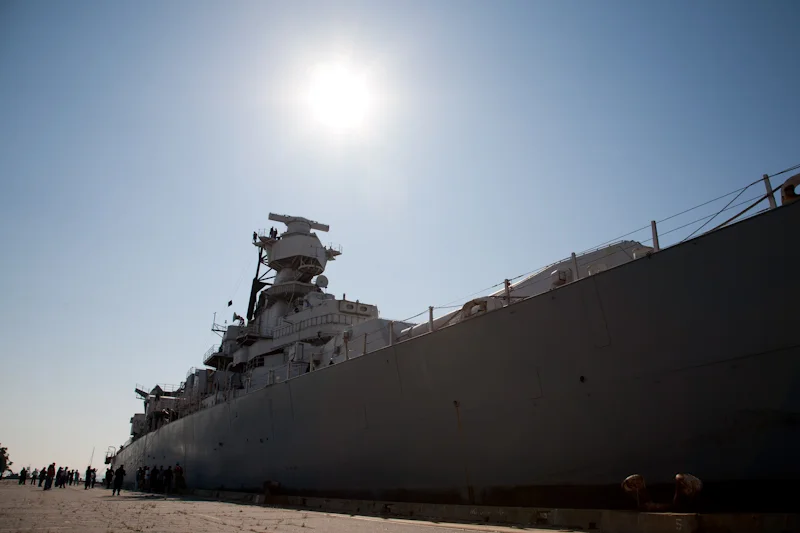
Arriving at Berth 3 in Richmond

Flying the US Flag in Richmond

Forward 16"/50 caliber Mark 7 guns

Portside guns, 5"/38 caliber twin turrets

Securing the mooring lines

Crew

Crew

WWII Veteran Joe served aboard USS Iowa during her first deployment in 1942.
Photo: "Rockweed"

Decayed bathroom inside Norwich State Hospital's Salmon Building, designed for the male criminally insane.
Photo: "Seaweed"

Patient tub inside a patient treatment building, Canaan Hall, at a Connecticut Hospital.
Photo: "Chapel"
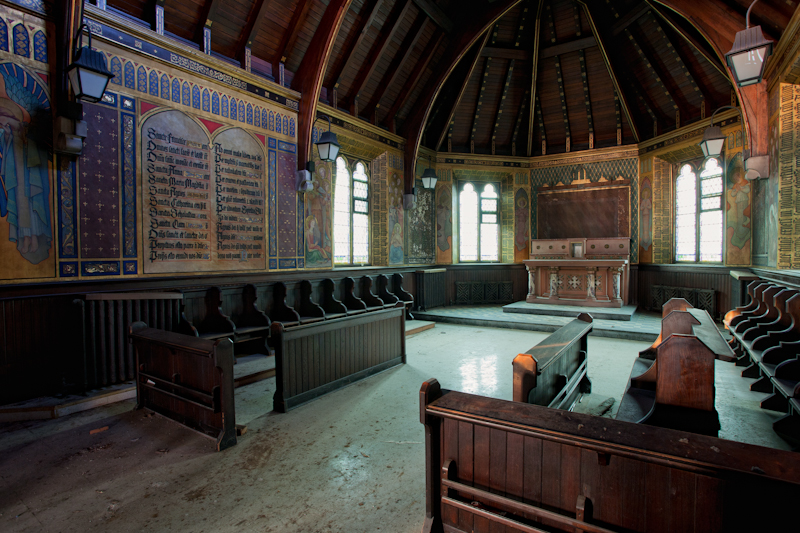
The second floor chapel inside the Abbey building of the St. Mary's Convent on Mount St. Gabriel in Peekskill, New York provided services for the ailing nuns residing within the Abbey.
Photo: "Diamond Light"

Sunset inside Norwalk Hall, employee housing, at a Connecticut State Hospital. The hospital was in operation from 1931 to 1995 and once housed 4,000 patients, 20 doctors and 50 nurses.
Photo: "One Star"

Galt Building at Norwich State Hospital, a former psychiatric hospital in Preston, Connecticut.
Photo: "Tub"

The Canaan House at an East Coast State Hospital, was used for patient treatment and housing.
Photo: "O2"

Looking out onto a porch inside the Bell building, patient building, at Norwich State Hospital, a former psychiatric hospital in Preston, Connecticut.
Photo: "Spun"
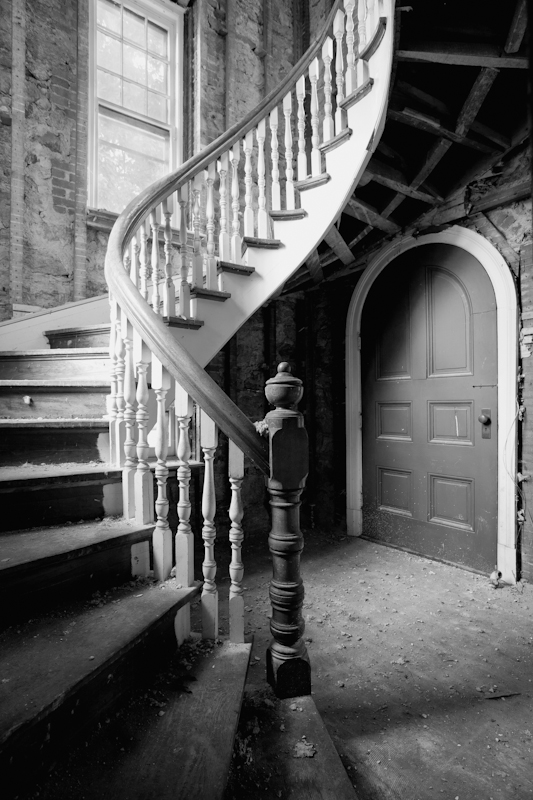
Spiral staircase leading from first floor to third floor inside the 1876 Abbey of the Community of St. Mary in Peekskill, New York.
Photo: "Shower Room"

Employee shower room in the New Milford Plant of the Hackensack Waterworks in New Jersey.
(Dark interior, 90 seconds. Lit by incandescent and LED flashlight.)
Photo: "Brazen"

Patient room window in the male ward at Hudson River State Hospital in Poughkeepsie, New York.
Photo: "Distant"

Nurse quarters at Fairfield Hills State Hospital.
This former psychiatric hospital in Connecticut, received its first patient in 1933 from the nearby Connecticut Valley State Hospital. When the hospital opened, there were only 500 patients and 3 doctors, but by the 1960's, Fairfield was home to 4,000 patients, 20 doctors and 50 nurses, who were living in these nurses quarters. Treatments included hydrotherapy, insulin in shock therapy, patient seclusion, electric shock therapy and frontal lobotomy. A number of accounts of patient cruelty were reported while the hospital was in operation. In 1995 when the hospital closed patients were transfered back to Connecticut Valley Hospital.
Photo: "Stop Falling"

In 2007 the male wings of the hospital were severely destroyed by a fire caused by a lightning strike.
Hudson River State Hospital in Poughkeepsie, New York was designed by Frederick Clarke Withers and was the first institutional building designed in the High Victorian Gothic style. Though designing began in the 1860's, construction was behind schedule and over budget. The facility opened in 1871, however construction continued throughout the last three decades of the 19th century. The administration building and wings followed the Kirkbride plan and was 1,500 feet long in total.