

Construction began on this rural New York psychaitric hospital in 1927. At the time, the hospital was known to be the best of its kind in the country. It contained a working farm, power plant and industrial shops. Portions of the hospital are still in use, but buildings such as this one have been abandoned for years.
Photo: "UBD602"

Big M Auto. Williams, CA.
Night. Full moon. 180 seconds. Lit by moonlight.
Photo: "Asbestos"
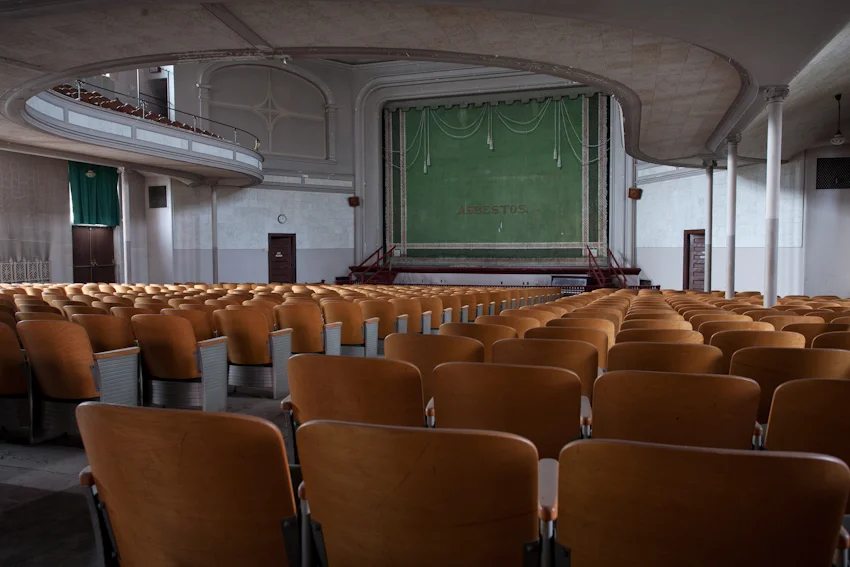
Dawn inside Noble Hall, an East Coast psychiatric hospital theatre built in 1908 in the Colonial Revival style.
Photo: "Mesh"

Isolation cell door inside Salmon building at Norwich State Hospital.
This building was home to the male criminally insane, deemed "not guilt by reason of insanity" and the violent patients that had to be transferred out of the other hospital wards.
Photo: "Medicine Room"

Building 17, a patient housing and treatment building, at a Pennsylvania State Hospital was abandoned in the 1960's. Since then, it has been used for a number of fire department exercises, which has left large holes in the walls and a portion of the building charred.
Photo: "Dry Docked"

Cruise Ship docked at Pier 70 in San Francisco.
Photo: "amf"

This bowling alley is part of a rural New York Psychiatric Hospital founded in 1927.
Photo: "Impeccable Timing"

Big M Automotive. Williams, California.
Night. Full moon. 210 seconds. Lit by moonlight and incandescent flashlight.
Photo: "Stripes"

Pool table inside a bowling alley at a 1920's State Hospital, constructed in rural New York to get patients away from the big city. In 1931, the hospital opened with 60 male patients, transferred from another hospital, but at the peak in 1959, the hospital had 7,000 patients and 2,000 residents.
Photo: "Mezzanine"

Noble Hall, an 830-seat theate belonging to an East Coast psychiatric hospital, was constructed in 1908 and designed by architect William D. Johnson.
COAST Flashlight: HP7 Review
I recently received the COAST HP7, a high output LED flashlight. It shipped in a custom box containing the flashlight, a pouch and strap.

Features
- High (207 lumen flood) & Low (20 lumen spot) Beam Output settings
- Beam Focus and lock- Uses (4) AAA batteries
- Impact and water resistant
- Battery Life: 5-10 hours
- Dimensions: 5.54" x 1.24"
- Lightweight (7.2oz)
Construction
The HP7 is lightweight and durable, made of aluminum, and has a slight texture around the barrel of the light making it grip well in your hand. It's bigger than most handhelds I own, but still small enough to fit comfortably in your hand, a deep pant or jacket pocket, though it's slightly too long to fit in a pocket of the women's jeans I own. It also is small enough for a camera bag, glovebox, backpack or toolbag.
The push/pull feature of the beam focus is smooth. It works best when using your thumb (not forefinger as shown in the diagram), but it's still a bit stiff and not easy to do with one hand. I found the beam focus lock to be helpful, but it didn't always lock well and often it would slip when pulling the light out of a tight pocket.
This light runs on just (4) AAA batteries and ran strong for about 4 hours at high power before beginning to dim.
(Left below) Front element; (Right below) Rear on/off button

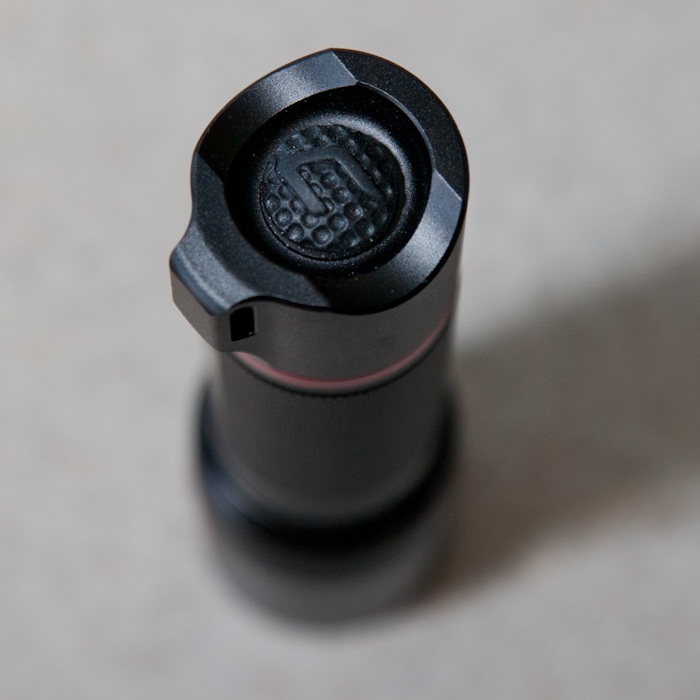
Output/Beam
I found the two output settings to be very useful. The high output setting at 251 lumens was too bright for navigating the dark since it killed my night vision, but worked well for light painting subjects from 20ft or more. The low 58 lumen setting was better suited for navigating or light painting detail shots.
The HP7 beam is impressive. When the beam is at the narrowest setting, it contains a hot spot, but at a distance of more than 10 feet, that hot spot has smooth edges. When the beam is set on the widest setting, there is almost no perceivable hot spot. It's smooth all the way through with a nice smooth, feathered edge.
The HP7 has a fairly consistent cool color temperature, with a slight green-ish hue that's most noticeable around the edges when set to the wide beam setting (see below.)
(Left below) Showing high output beam, wide; (Right below) Showing high output beam, narrow


(Below) HP7 on high output setting against white wall showing green tones around the outer edges of the beam.

Recommended Uses
- Photography: Bright light, good for light painting. Small enough to fit in a camera bag.
- Night Navigation: Dual brightness modes are good for navigation. Dim mode isn't so bright it destroys night vision, but high output mode is good for seeing long distances.
- Vehicle: This light's long run time and bright beam make it a good light for car emergencies.
- Tactical: Lightweight and small for how bright it is.
Sample Photos

Full moon night. 120 second exposure. f/9. ISO 200. Right face of structure lit with HP7 flashlight on high setting for approximately 15 seconds from 50+ feet away.

Full moon night. 9 seconds. f/5. ISO800. Lit by HP7 on high setting, in left hand.
Night. 40 seconds. f/9. ISO 100. Lit from camera perspective using wide beam for foreground and narrow beam farther down tunnel.
Full moon night. 9 seconds. f/5.6. ISO 800. Lit via HP7 on high setting, held in right hand.

Full moon night. 9 seconds. f/5.6 ISO 800. Lit with HP7 on high setting, off camera right.


Before (left) and after (right) using the HP7 at high power setting.
Photo: "Eight and Nine"

The four women's wards at this New York Tuberculosis Sanatorium, designed by architect Raymond F Almirall, were constructed between 1909-1911. Buildings 1, 3 and 4 were the general ward pavilions for women. Building 2 was the private room ward. The four story buildings were constructed with Southern Facing Solariums and the narrow rectangular shape helped greatly with cross-ventilation.
Photo: "Rodeo Beach"

Photo: "Mattress Wars"

Patient beds inside the Galt building at Norwich, a Connecticut State Psychiatric Hospital founded in 1904.
Photo: "Freon Control"
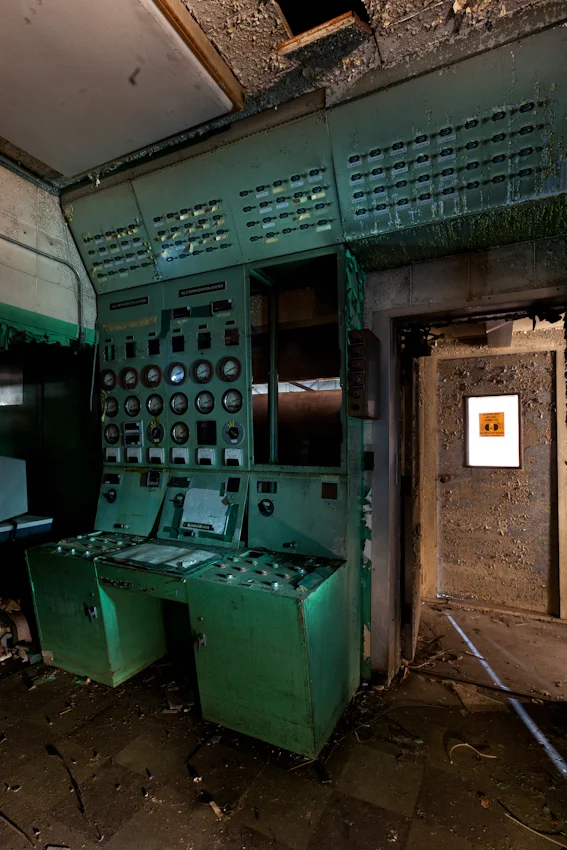
Control room at the Naval Air Warfare Center. (Dark room. Light painted with LED and incandescent flashlights.)
This control panel was responsible in controlling the distribution of Freon throughout the complex. Freon was used to help reduce the chance of a fire amongst aircraft propulsion systems, tested in various portions of the facility including the second floor of this building.